Showing posts with label Paris. Show all posts

Tuesday, December 18, 2012

MAM temporary exhibition: Art in/at War, France

Temporary exhibits are the most exciting part of any museum, in my opinion. It is within them that you can truly see a museum's value system and curator's perspective in the way in which they choose to situate a unique collection... of art, for example. Susan Power also attributes temporary exhibitions "to attract increasingly larger number of visitors."
The current temporary exhibition at the MAM was certainly crowded during my visit last week. It showcased "over 400 works of art and documents created/displayed in France during the decade bracketing World War II . . . a crucial and tragic moment in the museum's history." The exhibition was organized chronologically, displaying pieces that had been visible at the time, in addition to those that were not. Lighting was low and very little description was given except for blocks of contextual text at the beginning of each section. For this reason I don't think I'd be able to appreciate the amazing juxtaposition of it all--which, I believe, is the most valuable part--had I not been on a guided tour.
Each piece was so moving, not solely for its artistic composition but for its ideology.There were propaganda-like works for the Vichy government (stylistically of modern and medieval themes), pieces that served as acts of subtle resistance by artists in exile and those kept under lock and key (Picasso, for instance), classic facist art, and even those that had been created by artistically-inclined prisoners at the detention camps with the limited material available:
And it closed and ended with surrealist works; the first that had been displayed perhaps with an unconscious premonition of what's to come and the last with a conclusive return of artists to the scene, with the outstanding intention of performing a change on the visitor. The art, degenerate or not, intentionally (and unintentionally) expressed the most barbaric parts of the war. The exhibition thus professed a profoundly political and ethical narrative.

Thursday, November 29, 2012

La brocante by happenstance

My mom and sister came to visit me over their Thanksgiving break. It was their first time in Paris. As eager as I was to bring them museums though, I was also adamant about creating a unique, non-touristy experience. For their first full day then, I proposed a walking tour, and much to my delight, we happened to stumble upon a brocante.
 "In the late 19th century, not that long before the walls were razed [in Paris], beggars and drifters were chased out of town by city ordinance, and so were the chiffonniers, or ragpickers, who scoured the streets by night scavenging discarded goods to sell by day. They were known as biffins (foot-soldiers) or crocheteurs—either a porter who carries heavy goods on crochets (hooks), or a lock picker, possibly indicating that some of the scavenged goods had not yet been discarded. They were also called pêcheurs de lune, or fishermen of the moon.
Ousted, they began to congregate just beyond the fortifications, near the portes of Montreuil, Vanves and Clignancourt, to sell their ragged wares, and gradually the flea markets took shape. The “flea” tag may have come from the scruffy condition of sellers and stuff, but the semi-official story goes that an observer, looking down from the heights of the fortifications, saw the tiny figures far below as flea-sized. Either way, the name stuck, and eventually the markets became popular—even fashionable—spots for weekend chineurs (bargain hunters) out to fouiner (nose around) for antiques and brocante (bric-a-brac). "
Thanks to Judy Fayard's words in a September 2010 issue of France Today, now you and I both know.

It was pretty amazing to think that myself, my mom, and my sister, all appreciators of antique items--paintings, art deco, ceramics, furniture from the 60s and 70s, silver, vintage clothing, kitchenware, jewelery--were in a place where the entire concept of an antique market began. Especially being that Paris literally has more history than New York.
paintings, ceramics, silver, art deco, 60s and 70s items, linens, books, militaria, kitchenware, - See more at: http://www.fleamarketinsiders.com/best-flea-markets-in-france/#sthash.ZvG5I1Sz.dpuf

One man's trash is another man's treasure; and as such, they left with a few one-of-a-kind souvenirs.
I'm not sure if this particular brocante takes place weekly, but if so, you can visit it in the norther Marais on Friday mornings. Metro Temple is best. Otherwise, check out this comprehensive list from The Guardian.

Monday, November 19, 2012

Out of this World - le musée du quai Branly

"Every aspect of a museum, gallery, or heritage site communicates. From the architectural style of the building or layout of a site, to the attendants at the entrance, the arrangement of the exhibits or artifacts, the colour of the walls, and the positioning and content of labels and text panels; all these things and more are engaged in a communicative process with the visitor." -Rhiannon Mason, Museums, galleries and heritage: Sites of meaning-making and communication
For these very reasons, even the central glass column filled with musical instruments which acts as the backboard to the musée du quai Branly can be controversial. In my opinion: it shows objects on display which--although for the most part made to be seen--are intended more so to use. It organizes objects by region with scientific numbers which further separates the visitors from the cultures the objects represent. For a museum which is meant to be so revolutionary, it's nearly as imperialistically-insulting as museums have always been. Daniel Sherman notes, "Rivet [the first director of the Musée de l'Homme] ;preferred to avoid evolutionary schemas altogether, noting that the people ethnographers would encounter in the French empire 'are as far, perhaps even farther, from their origins as we; it is just that their civilization has evolved in a different direction from ours'." In this case, few things have changed.
"Who, after all, is best qualified by experience' (what kinds?), by depth and breadth of knowledge (what knowledge?), to control and interpret an African collection," asks James Clifford in Routes: Travel and Translation in the Late Twentieth Century. I expand the question to include any culturally-affiliated collection, which in those terms basically encompasses everything found with a museum. It matters because, "for example, depending on your point of view, an African mask could be viewed as an ethnographic exhibit, a tribal artefact, a piece of art, evidence of colonial looting, the subject of a repatriation case, or simply a commodity to sell," as described in ;Museums, galleries and heritage: Sites of meaning-making and communication by Rhiannon Mason. In creating a contemporary building surrounded by an "exotic" garden with a visitor route which simulates a futuristic river, any and all objects of the museum are placed in this context which further separates the museum experience, and thus the cultural significance of the objects themselves, from the every day life and identity of the museum visitor. Thus this museum is hardly "a contact zone."
And saying as such doesn't begin to address "looted third world art," to use the loaded terms of The New York Times. Perhaps it's too much to ask, but I believe a museum that claims to be ... should "be accountable in a way that went [goes] beyond mere preservation," in the words of James CliffordIf for no other reason than because, as Eilean Hooper-Greenhill acknowledges in Changing Values in the Art Museum: Rethinking Communication and Learning: "It is time for museum professionals to acknowledge and address the power of museums, to accept that museums are necessarily implicated in cultural politics, and that, therefore, professional practices have political."

Saturday, November 17, 2012

Introduction to the Musée du Quai Branly

Please note: The video blow includes iPhone-quality snapshots of permanent exhibits within the Musée du Quai Branly. The accompanying music is from the permanent exhibits as well but they have not been accurately matched with the exhibits themselves as there were more opportunities for visual display than that of audio.


Où? 37, quai Branly 75007 Paris
Quand? Tuesday, Wednesday, Sunday, 11am-7pm; Thursday-Saturday, 11am-9pm
Comment? Metro Alma-Marceau, Iéna, Ecole Militaire, Bir Hakeim 1; RER Pont de l"alma, Champ de Mars-Tour d'Eiffel; Bus 42, 92, 80, 63, 82, 72, 87, 69

Wednesday, November 14, 2012

The Beaubourg-Effect at le Centre Pompidou

In the past, "the building chosen to stand for the institutionalized museum is itself representative of a particular building type familiar to all of us who have visited the world's great museums," as described by Rosalind E. Krauss in Postmodernism's Museum Without Walls
Le Centre Pompidou, inaugurated on January 31st, 1977 as a cultural center, sought to change that notion.
Founded upon the concept of transparency as a means to create a democratic living space for the arts and the public, it appears to be inside out with structural aspects colorfully exposed.  Clearly this speaks to Stephanie Moser's reference in The Devil is the Detail: Museum Displays and the Creation of Knowledge: "'design plays a crucial role--not just in presenting content, but in actually creating it, (Serrell 2006:33)." Especially being that each color has a specific function: red=visitor circulation, yellow=electrical, blue=air, green=water.
As such, seeing the building for the first time is quite a shock. But it's nothing compared to walking inside. The main hall is open yet overwhelming with the opportunities to access a public library (Bpi), a center for industrial design (Cci), a contemporary music center (IRCAM), an auditorium, theater and cinema spaces as well as shops, cafés, a self-service post office and the acclaimed Restaurant le Georges.
There's "a heightened sense of individual free choice--a major theme of the building as a whole," similar to the MoMA museum in New York as Carol Duncan and Alan Wallach explained in The Museum of Modern Art as Late Capitalist Ritual: An Iconographic Analysis. Except, of course, that each facility has a separate entrance, fee, and security checks.

It's somewhat of a contradictory space, as Jean Baudrillard criticized in The Beaubourg-Effect: Implosion and Detterence; "a fluid communicative exterior--cool and modern--and an interior uptight with old values."

I won't say I agree completely, at least not as harsh of an extent, but I do see where he's coming from. Although intended to be revolutionary, the museum has mostly become what we expect museums to be: displayed art in an organized matter (sometimes by artist if they or their benefactor is wealthy enough) that is meant to be seen not touched.
As Emma Baker said in The museum in a postmodern era: the Musée d'Orsay case study: "...the building itself conceived as a kind of box divided by movable partitions for the sake of flexibility. The Pompidou Centre originally exemplified this type of museum, but its immense open spaces were converted into conventionally solid and permanent galleries during the 1980s."
Particular artists currently featured there are challenging this shift with interactive and/or multimedia displays of familiar objects in typical settings. An artistic feature which I don't doubt maintains the uniqueness of le Centre Pompidou in the eyes and experience of the average visitor.
And yet, to quote Andrea Fraser's article, Isn't this a wonderful place? (A tour of the Guggenheim Bilbao): "Like the philanthropic act of donation through which so many objects find their way into museum collections and on which so many museums themselves depend, the aesthetic and its institutions are both the product and the manifestation of a distance from economic necessity of economic power that is 'first and foremost a power to keep economic necessity at arm's length.'"
Où? Place Georges Pompidou, 75004 Paris
Quand? Daily except Tuesdays, 11am-9pm
Comment? Metro Rambuteau, Hôtel de Ville, Châtelet-Les Halles, RER Châtelet-Les Ailles, Bus 21, 29, 38, 47, 58, 69, 70, 72, 74, 75, 76, 81, 85, 96

Monday, November 12, 2012

Sounds of Le Marché de Clignancourt

Following a morning study session at KBCafeshop, I intended to go to Marchés aux puces de Saint-Ouen. According to Dixon Long and Marjorie R. Williams of Markets of Paris,"Thought it's called a flea market Clignancourt has evolved into an antiques market with a very large number of specialists, as well as generalists who offer everything from period armchairs to World War II aircraft parts."  I knew I'd appreciate the antiques despite the fact that I most likely wouldn't be able to afford them. But on my way from the metro, I got caught in the clothing and jewelry market.
It wasn't the selection nor the displays that caught my attention... it was the sounds. Unlike many of the markets I'd visited, French was not the predominant language, and many vendors were playing music I'd never heard before. Still, to be completely--though not unapologetically--honest, I didn't feel comfortable photographing or filming the scene. I didn't want to stand out any more than I already did. Instead, I decided to record it. Please enjoy the audio clip below:
Le Marché de Clignancourt
Où? Avenue de la Porte de Clignancourt & rue René Binet, 75018 Paris
Quand? Saturday, 8:30am-6:30pm; Sunday, 10am-6:30pm; Monday, 10:30am-5:30pm
Comment? Metro Porte de Clignancourt

Wednesday, November 7, 2012

The museum within the sewers

"There are twice as many meters of sewers as there are streets in Paris... it's like a town beneath a town."

What constitutes a museum? At first thought, the building itself. "The building chosen to stand for the institutionalized museum itself representative of a particular building type familiar to all of us who have visited the world's greatest museums," writes Rosalind E. Krauss in Postmodernism's Museum Without Walls. Upon further examination though, it's a lot more than that--objects are exhibited, maps direct, and both are adorned with labels so the visitor is clear on exactly what he or she is seeing and where he/she should go next. 
Le Musée des Égouts de Paris hardly contains any of these details as the creation of the museum itself was most certainly an after thought. I was lucky enough to visit with a guide during which time I learned that  Napoleon commissioned the sewage system that is still actively used today; until 1920, Parisians (albeit bourgeoisies) were invited to take tours of the sewage system via cars and boats; workers appreciate the rats because they (1) help with eating the garbage and (2) give warning to any danger; and finally, until 2004; government officials could send messages through pipes from the Senate to the Parliament building. Interesting? Yes. Unique? For sure. I'm glad I went, and I doubt I'd ever go again. The smell is hardly pleasant.

Charles Landry said, "At their core museums and galleries are involved in an exchange of ideas where we as the visitor come to grips with displays. In effect we converse either with ourselves or more publicly about what our culture or those of others is so we think about what we value and what our values are." Thank God for public workers...
Où? Across from 93, quai d'Orsay, 75007 Paris
Quand? Monday-Wednesday, Saturday, Sunday, 11am-4pm
Comment? Metro: Alma-Marceau; RER: Pont de l'Alma

Sunday, October 28, 2012

Appreciating le Musée Jacquemart-André

Private art museums are quite astonishing entities. In addition to displaying unique and personal collections, they "afford visitors the rare opportunity to take a peek into the lives and passions of some of the world’s wealthiest and most powerful people, " as written by Emma Solely for Departures.com. And interestingly enough, we may have these wealthy and powerful people to thank for the creation of the museum in the first place. As published on FT.com"What is generally considered to be one of the world’s first museums opened circa 1628 in Kennington, London, where John Tradescant would take visitors around his collection of curiosities gathered from his travels."
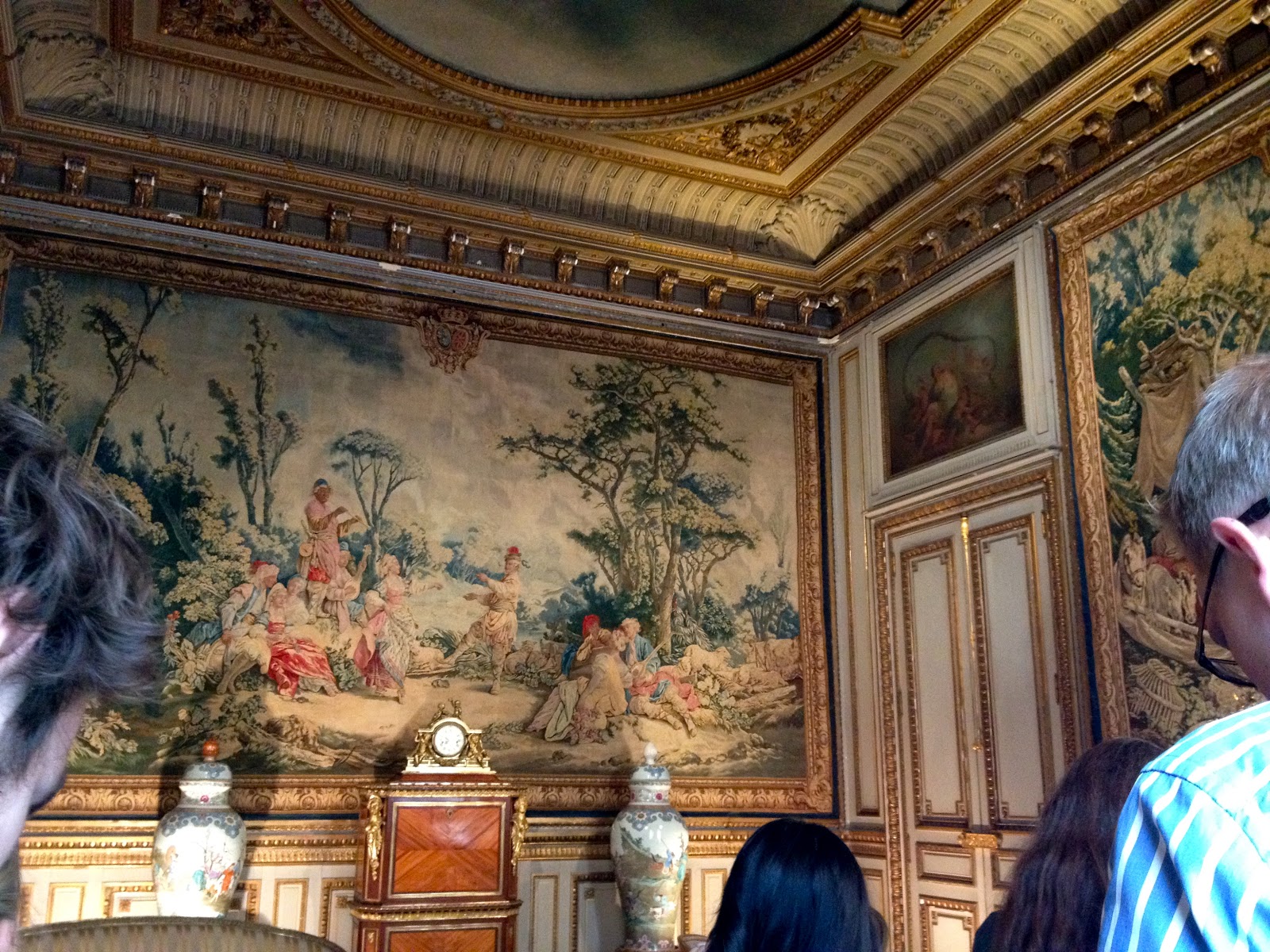
This past week, I had the opportunity to view the eclectic and refined tastes of Eduoard André and Nelly Jacquemart. Over a hundred years ago, they built a small palace within Paris to display their extraordinary collection and then bequeathed it in its entirely to the Institut de France in 1911. It was to be opened as a museum for the public though the layout could be changed and no art could be lent. It's amazing to think it is still just as dazzling a sight as it was then.
Spectacular, isn't it? And yet I found it most interesting to observe the visitors who were notably more mature and seemingly more cultured. This was visible in the clientele of the beautiful café and could also be inferred by the more expensive admission price (11 euros). I'd say it was worth it though. I especially loved the original work of Botticelli and Rembrandt and the visit is undeniably peaceful--it's as if you become privileged too by simply being there.

Le Musée Jacquemart-André
Où? 158, boulevard Haussmann, 75008 Paris
Quand? Daily,10am-6pm
Comment? Metro: Saint-Augustin, Miromesnil, Saint-Philippe du Roule, RER Charles de Gaule-Étoile, Bus 22, 43, 52, 54, 28, 89, 83, 84, 93

Tuesday, October 16, 2012

Organic at Le Marché Batignolles

France isn't just a country that appreciates meal time, it's also a country that frowns upon many of the practices that have, in my humble opinion, spoiled the American food system. The French have been actively resisting GMOs and many of the pesticides which have been approved and promoted within agriculture in the U.S. Some have also gone as far as to jump on the organic, or rather, "bio" food wagon. Although I can't say I only eat organic--I neither have the budget nor the patience to do so--I do value it in the sense that I believe it's the way all food should be.
Lucky for me, Paris market culture has embraced the belief as well. Le Marché Raspail (on Sunday mornings) is the largest organic food market in Paris, but the second largest is at Batignolles... exactly two metro stops away or a brisk 20-minute walk from my humble abode. It is teeming with fruits, vegetables, cheeses, meats, flowers, clothing, dairy products, breads, raw nuts, dried fruits, honeys, jams, and lightly prepared foods. In other words, it's a pesticide-fertizilizer-GMO-antiobiotic-hormone-(etc)-free feast for the eyes. Seriously though:
Though there have been countless debates as to whether organic food really is more nutritious, my belief is that it is most likely safer for our bodies and most definitely better for the environment. I, like many Parisians it seems, am very much committed to supporting the two.
Le Marché Biologique des Batignolles
Où? Boulevard des Batignolles from rue Turin to rue de Moscou, Paris 75017
Quand? Saturday, 8am-2pm
Comment? Metro Rome, Place de Clichy; Bus 30
(Originally published on www.danielle-abroad.com)

Monday, October 15, 2012

From Royal Garden to Natural History Museum

In Touch in Museums, editor Helen J. Catterjee references Donald Preziosi's development of Foucalt's thesis by concluding that: "the museum was not only productive of knowledge about objects but functioned as 'an instrument for the manufacture of ... societies, ethnicities, races, classes, genders, and individuals; of history, progress, and moralities (ibid)."
As such, it is no surprise that le Musée d'Homme is under renovation as I discussed in my previous post. It does bring to question the museums of "natural history" however.
In the first place, "natural history" infers that this history in an absolute, indisputable truth, and it is perhaps with this conclusion that those who were excavating for museum materials (most notably skeletons of extinct plants and animals) justified their quests throughout the world. The Galleries de Paléonthologie et d'Anatomie comparée compare such materials in an encyclopedic matter. Dinosaurs for example, have been reconstructed and displayed with pride in order of their development and extinction with a nod to the place in which their remains were found.
The Grande Gallerie de l'Evolution, on the other hand, has taken a more "modern approach." Housed in a similarly open and airy environment, natural light is replaced with colored lights which, in my opinion, provide a more "science fiction" feel. Animals are displayed with labels in modern glass cases or in the center in of the rooms where they appear to migrating, hunting, or playing with each other. Interactive activities invite children and adults to get a sense of their natural environments and identifying characteristics. There is even an educational space specifically for children.
It is as if, in Judith Matsai's terms, the museum's philosophy is such that "the museum is an education resource for lifelong learning, [and thus] the task changes in order to identify multiple points of entry for visitors of many sorts and kinds, based on differences in age, gender, race, ethnicity, levels of knowledge about history, about art history, and so on."
Both strategies are, in my opinion, effective, but the visitor to the Grande Galerie de l'Evolution is made to feel more a part of the natural and historical development of the world. There direct relationship between man and animals is discussed (due in no small part to the fact that they simultaneously exited--as opposed to most if not all of the creatures displayed in the Galeries de Paléonthologie et d'Anatomie comparée). As seen in the photo above, s/he is even, as seen above, called to question the role s/he plays in nature as the world continues to develop.

Friday, October 12, 2012

Harvesting Equality at Le Jardin des Plantes

What began as Le Jardin de Roi, has become an institution for scientific, historic, and obviously, botanical study. The grand buildings surrounding the beautiful French-style gardens include the Mineralogy and Geology Gallery, Discovery Room, Paleontology and Comparative Anatomy Galleries, The Grand Gallery of Evolution, The History of the Jardin des Plantes, and a small zoo. Many exhibits are interactive, too. It's no wonder it attracts families from all over the world.
And it is perhaps for this very reason that le Musée d'Homme has closed. "The formation of the public museum embodies a principle of general human universality in relation to which, whether on the bias of the gendered, racial, class or other social patterns of its exclusions and biases, any particular museum display can be held to be inadequate and therefore in need of supplementation." (Tony Bennett, The Birth of the Museum, p. 91) Being that the museum was founded in the 18th century and has displayed human evolution ever since, many controversial issues must be addressed before its projected reopening in 2014. There's great potential for social change if accomplished effectively.
Où? 52 rue Cuvier, 2 rue Buffon, 36 rue Geoffrey-Saint-Hiliare, place Valhubert, 75005 Paris
Quand? Daily, 7:30am-7:45pm (summer); Daily, 8am-5:30pm (winter) - individual museum hours vary
Comment? Metro Austerlitz, Censier Daubenton, Jussieu; RER C; Bus 24, 57, 61, 63, 67, 89, 91