Showing posts with label History. Show all posts

Tuesday, December 18, 2012

MAM temporary exhibition: Art in/at War, France

Temporary exhibits are the most exciting part of any museum, in my opinion. It is within them that you can truly see a museum's value system and curator's perspective in the way in which they choose to situate a unique collection... of art, for example. Susan Power also attributes temporary exhibitions "to attract increasingly larger number of visitors."
The current temporary exhibition at the MAM was certainly crowded during my visit last week. It showcased "over 400 works of art and documents created/displayed in France during the decade bracketing World War II . . . a crucial and tragic moment in the museum's history." The exhibition was organized chronologically, displaying pieces that had been visible at the time, in addition to those that were not. Lighting was low and very little description was given except for blocks of contextual text at the beginning of each section. For this reason I don't think I'd be able to appreciate the amazing juxtaposition of it all--which, I believe, is the most valuable part--had I not been on a guided tour.
Each piece was so moving, not solely for its artistic composition but for its ideology.There were propaganda-like works for the Vichy government (stylistically of modern and medieval themes), pieces that served as acts of subtle resistance by artists in exile and those kept under lock and key (Picasso, for instance), classic facist art, and even those that had been created by artistically-inclined prisoners at the detention camps with the limited material available:
And it closed and ended with surrealist works; the first that had been displayed perhaps with an unconscious premonition of what's to come and the last with a conclusive return of artists to the scene, with the outstanding intention of performing a change on the visitor. The art, degenerate or not, intentionally (and unintentionally) expressed the most barbaric parts of the war. The exhibition thus professed a profoundly political and ethical narrative.

Monday, October 22, 2012

Great Britain at the British Museum

This past weekend, I ventured to London with one of my classes. Although our itinerary was pretty intense the first two days, we were left to explore during the entirety of Saturday. Mary and I decided to peek into London's national identity and find out what a "vast collection of world art and artefacts" looks like with a (free!) visit the British museum.

The immense main hall (through which one arrives after passing through the main entrance) is incredible. With such tall ceilings and a circular shape, it felt as though we were standing in the center of the Universe. And in some ways, I suppose, we were. The full range of exhibits could be accessed by taking a hallway (corridor) or staircase and there were various services to make the experience more enjoyable: an Information desk, the Gallery Café, "the Families Desk", the Museum Shop, the Multimedia desk (a Korean Air sponsorship offered free audio guides).
With free maps in hand, we set out "to experience some of the highlights of the magnificent permanent collection."

Of the most ancient artifacts, I realized many had originated in many former British colonies. It was almost ironic yet not at all that they were still being showcased with such esteem. After all, at one time the British Empire was the largest, wealthiest, and yes, greatest. The physical evidence of such power appeared to be the most popular amongst visitors and the free tours and talks scheduled throughout the day.

To enhance the privileged opportunity, the Museum offers opportunities to touch objects and learn more about them under the supervision of experts. I believe the intention is that which Fiona Candlin hypothesizes in The Dubious Inheritance of Touch: Art History and Museum Access, "touch potentially opens up previously prohibited ways of understanding museum collections and includes visitors who have traditionally been marginalized by an emphasis on visual learning. As such, it could represent a new and positive step towards recognizing different forms of knowledge and in correlation acknowledges the rights of blind people, among others, to access their collective cultural heritage."

Ancient Greek and Roman artifacts and the rotating exhibitions were accessible from the upper floors as well. On our visit, they were displaying Spanish prints and drawings from the Renaissance to the time of Goya, in addition to a look at the significance of water, tea, and wine across Asian cultures. A visual history of Europe was additionally on display.
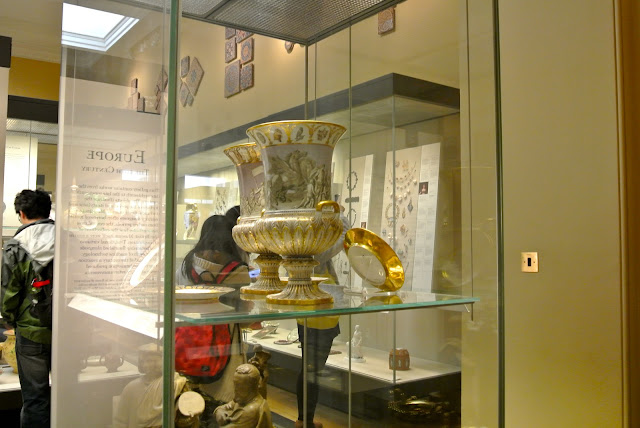
The biggest crowds I saw, however, could be found on the ground floor. Not in the Americas exhibits, nor of those of China, South Asia, and Southeast Asia, but in room 4: Egyptian sculpture. It is here that The Rosetta Stone is set on display surrounded by thick glass. I'd assume that this amazing "key to deciphering hieroglyphics" tops the list of A History of the World in 100 Objects written by British Museum Director in conjunction with BBC Radio.
Où? Great Russell Street, WC1B 3DG, London
Quand? Daily,10am-5:30pm; Friday, 10am-8:30pm
Comment? Tube, Tottenham Court Road, Holborn, Russel Square, Goodge Street; Bus 1, 7, 8, 19, 25, 38, 55, 98, 242, 10, 14, 24, 29 73, 134, 390, 59, 68, X68, 91, 168, 188

Thursday, October 4, 2012

Musée national du Moyen Age

We had a very rainy morning in Paris last Thursday. Usually, this wouldn't be much of a problem; I'd put on my boots and raincoat, grab an umbrella, and duck into the nearest café to study... or, I'd just be in class. As it was, I had class, but the professor proposed a 2-hour scavenger hunt through the Latin Quarter. Had the weather been nice I would've appreciated it. Since the weather was not, I couldn't wait for it to end at Cluny. What an exquisite historical retreat!
Où? Hôtel de Cluny, 6, place Paul Painlevé 75005 Paris
Quand? Monday, Wednesday-Sunday, 9:15am-5:45pm
Comment? Métro Cluny-La Sorbonne, Saint-Michel, Odéon; Bus 21, 27, 38, 63, 85, 86, 87; RER Saint-Michel, La Sorbonne

Monday, September 24, 2012

Musée Carnavalet

This past Sunday, my best friend and I accidentally stumbled upon le Musée Carnavalet. Admittingly, we hadn't meant to pay the museum a visit, but after wandering through the exhibits for a while and then being unable to find our way out (thus wandering through the exhibits a while longer), I'm pretty sure we covered the entirety of Paris' history...
 
 
Stunning, isn't it all? I should get lost more often. Paris is apparently the most perfect place for it.
Musée Carnavalet
Où? 23 rue de Sévigné, 75003 Paris
Quand? Tuesday-Sunday, 10am-6pm
Comment? Metro Saint-Paul, Rambuteau, Chemin Vert; Bus 29, 69, 76, 96