Showing posts with label Paintings. Show all posts

Tuesday, December 18, 2012

MAM temporary exhibition: Art in/at War, France

Temporary exhibits are the most exciting part of any museum, in my opinion. It is within them that you can truly see a museum's value system and curator's perspective in the way in which they choose to situate a unique collection... of art, for example. Susan Power also attributes temporary exhibitions "to attract increasingly larger number of visitors."
The current temporary exhibition at the MAM was certainly crowded during my visit last week. It showcased "over 400 works of art and documents created/displayed in France during the decade bracketing World War II . . . a crucial and tragic moment in the museum's history." The exhibition was organized chronologically, displaying pieces that had been visible at the time, in addition to those that were not. Lighting was low and very little description was given except for blocks of contextual text at the beginning of each section. For this reason I don't think I'd be able to appreciate the amazing juxtaposition of it all--which, I believe, is the most valuable part--had I not been on a guided tour.
Each piece was so moving, not solely for its artistic composition but for its ideology.There were propaganda-like works for the Vichy government (stylistically of modern and medieval themes), pieces that served as acts of subtle resistance by artists in exile and those kept under lock and key (Picasso, for instance), classic facist art, and even those that had been created by artistically-inclined prisoners at the detention camps with the limited material available:
And it closed and ended with surrealist works; the first that had been displayed perhaps with an unconscious premonition of what's to come and the last with a conclusive return of artists to the scene, with the outstanding intention of performing a change on the visitor. The art, degenerate or not, intentionally (and unintentionally) expressed the most barbaric parts of the war. The exhibition thus professed a profoundly political and ethical narrative.

Thursday, December 6, 2012

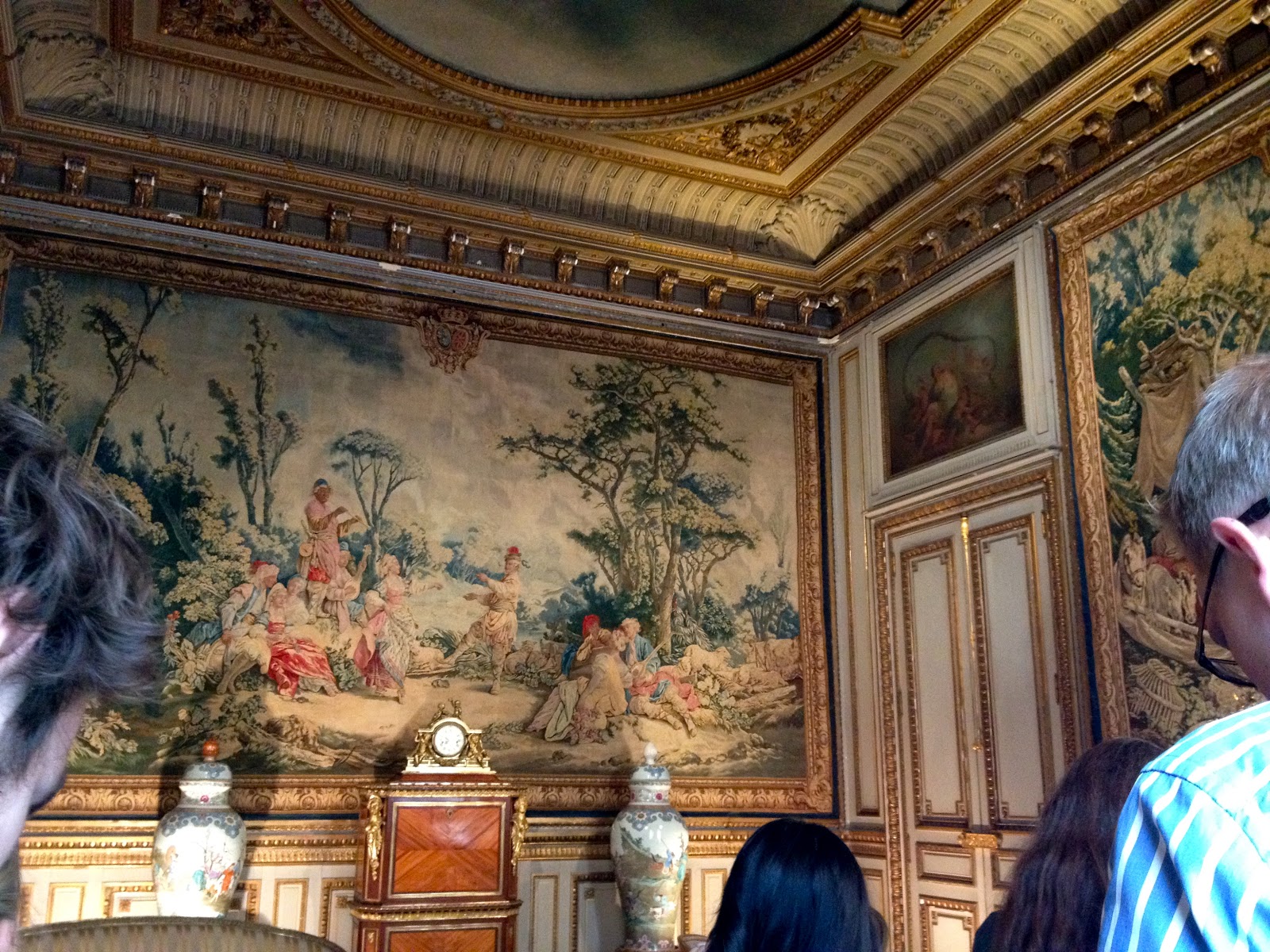
Le Château de Fontainebleau

Imagine a museum, any museum... what do you see? Usually, a classical building filled with historically-relevant art of some kind or perhaps a modern space made up of interactive science exhibits. In France, amongst other Western European cities with extended imperial pasts, castles and/or palaces have also taken on the role of "the museum."
"The meanings that we attempt to attach to objects are dependent on historical context and the multiple collective memories that shape their reception," (Crane, 2011, p. 107).
To a culture who so strongly values their "cultural" accomplishments, a castle or palace, hundreds and hundreds of years old, is the perfect place to literally set the scene. For a visitor, it also brings the museum experience to the next level. I was so pleased to have had the opportunity to visit le Château de Fontainebleau the weekend before last.
My mom and sister had the audio guide while I chose to wander through on my own. It's probably a bit embarrassing to admit, but I felt like I was on the set for The Three Muskateers or Marie Antoinette.
Not that I believe either were shot here, per se. Arguably more interesting (and most definitely more historically accurate) is the fact that le Château de Fontainebleau is one of the few in France that was consistently habituated, from the François I in the 16th century all the way to the reign of Napoleon III.
Indeed, "the material word," and I'd argue, world, "carries weight--aura, evidence, the passage of time, the signs of power through accumulation, authority, knowledge, and privilege," (Witcomb, 2007, p. 36).
Où? Château de Fontainebleau, 77300 Fontainebleau
Quand? Wednesday-Monday, 9:30am-5pm
Comment? TGV (from Gare de Lyon)

Friday, November 30, 2012

Lukas - the museum in digital

"Lukas manages digital imagery of the finest works and masterpieces of Flanders’ artistic heritage at the behest of museums and heritage organizations." With this video, they also become a digitalized museum. Watch and be amazed:
This goes against everything we define as "a museum", and yet... dare I say I love it? I wonder what Parisians would think.

Thursday, November 29, 2012

La brocante by happenstance

My mom and sister came to visit me over their Thanksgiving break. It was their first time in Paris. As eager as I was to bring them museums though, I was also adamant about creating a unique, non-touristy experience. For their first full day then, I proposed a walking tour, and much to my delight, we happened to stumble upon a brocante.
 "In the late 19th century, not that long before the walls were razed [in Paris], beggars and drifters were chased out of town by city ordinance, and so were the chiffonniers, or ragpickers, who scoured the streets by night scavenging discarded goods to sell by day. They were known as biffins (foot-soldiers) or crocheteurs—either a porter who carries heavy goods on crochets (hooks), or a lock picker, possibly indicating that some of the scavenged goods had not yet been discarded. They were also called pêcheurs de lune, or fishermen of the moon.
Ousted, they began to congregate just beyond the fortifications, near the portes of Montreuil, Vanves and Clignancourt, to sell their ragged wares, and gradually the flea markets took shape. The “flea” tag may have come from the scruffy condition of sellers and stuff, but the semi-official story goes that an observer, looking down from the heights of the fortifications, saw the tiny figures far below as flea-sized. Either way, the name stuck, and eventually the markets became popular—even fashionable—spots for weekend chineurs (bargain hunters) out to fouiner (nose around) for antiques and brocante (bric-a-brac). "
Thanks to Judy Fayard's words in a September 2010 issue of France Today, now you and I both know.

It was pretty amazing to think that myself, my mom, and my sister, all appreciators of antique items--paintings, art deco, ceramics, furniture from the 60s and 70s, silver, vintage clothing, kitchenware, jewelery--were in a place where the entire concept of an antique market began. Especially being that Paris literally has more history than New York.
paintings, ceramics, silver, art deco, 60s and 70s items, linens, books, militaria, kitchenware, - See more at: http://www.fleamarketinsiders.com/best-flea-markets-in-france/#sthash.ZvG5I1Sz.dpuf

One man's trash is another man's treasure; and as such, they left with a few one-of-a-kind souvenirs.
I'm not sure if this particular brocante takes place weekly, but if so, you can visit it in the norther Marais on Friday mornings. Metro Temple is best. Otherwise, check out this comprehensive list from The Guardian.

Saturday, November 17, 2012

Introduction to the Musée du Quai Branly

Please note: The video blow includes iPhone-quality snapshots of permanent exhibits within the Musée du Quai Branly. The accompanying music is from the permanent exhibits as well but they have not been accurately matched with the exhibits themselves as there were more opportunities for visual display than that of audio.


Où? 37, quai Branly 75007 Paris
Quand? Tuesday, Wednesday, Sunday, 11am-7pm; Thursday-Saturday, 11am-9pm
Comment? Metro Alma-Marceau, Iéna, Ecole Militaire, Bir Hakeim 1; RER Pont de l"alma, Champ de Mars-Tour d'Eiffel; Bus 42, 92, 80, 63, 82, 72, 87, 69

Wednesday, November 14, 2012

The Beaubourg-Effect at le Centre Pompidou

In the past, "the building chosen to stand for the institutionalized museum is itself representative of a particular building type familiar to all of us who have visited the world's great museums," as described by Rosalind E. Krauss in Postmodernism's Museum Without Walls
Le Centre Pompidou, inaugurated on January 31st, 1977 as a cultural center, sought to change that notion.
Founded upon the concept of transparency as a means to create a democratic living space for the arts and the public, it appears to be inside out with structural aspects colorfully exposed.  Clearly this speaks to Stephanie Moser's reference in The Devil is the Detail: Museum Displays and the Creation of Knowledge: "'design plays a crucial role--not just in presenting content, but in actually creating it, (Serrell 2006:33)." Especially being that each color has a specific function: red=visitor circulation, yellow=electrical, blue=air, green=water.
As such, seeing the building for the first time is quite a shock. But it's nothing compared to walking inside. The main hall is open yet overwhelming with the opportunities to access a public library (Bpi), a center for industrial design (Cci), a contemporary music center (IRCAM), an auditorium, theater and cinema spaces as well as shops, cafés, a self-service post office and the acclaimed Restaurant le Georges.
There's "a heightened sense of individual free choice--a major theme of the building as a whole," similar to the MoMA museum in New York as Carol Duncan and Alan Wallach explained in The Museum of Modern Art as Late Capitalist Ritual: An Iconographic Analysis. Except, of course, that each facility has a separate entrance, fee, and security checks.

It's somewhat of a contradictory space, as Jean Baudrillard criticized in The Beaubourg-Effect: Implosion and Detterence; "a fluid communicative exterior--cool and modern--and an interior uptight with old values."

I won't say I agree completely, at least not as harsh of an extent, but I do see where he's coming from. Although intended to be revolutionary, the museum has mostly become what we expect museums to be: displayed art in an organized matter (sometimes by artist if they or their benefactor is wealthy enough) that is meant to be seen not touched.
As Emma Baker said in The museum in a postmodern era: the Musée d'Orsay case study: "...the building itself conceived as a kind of box divided by movable partitions for the sake of flexibility. The Pompidou Centre originally exemplified this type of museum, but its immense open spaces were converted into conventionally solid and permanent galleries during the 1980s."
Particular artists currently featured there are challenging this shift with interactive and/or multimedia displays of familiar objects in typical settings. An artistic feature which I don't doubt maintains the uniqueness of le Centre Pompidou in the eyes and experience of the average visitor.
And yet, to quote Andrea Fraser's article, Isn't this a wonderful place? (A tour of the Guggenheim Bilbao): "Like the philanthropic act of donation through which so many objects find their way into museum collections and on which so many museums themselves depend, the aesthetic and its institutions are both the product and the manifestation of a distance from economic necessity of economic power that is 'first and foremost a power to keep economic necessity at arm's length.'"
Où? Place Georges Pompidou, 75004 Paris
Quand? Daily except Tuesdays, 11am-9pm
Comment? Metro Rambuteau, Hôtel de Ville, Châtelet-Les Halles, RER Châtelet-Les Ailles, Bus 21, 29, 38, 47, 58, 69, 70, 72, 74, 75, 76, 81, 85, 96

Sunday, October 28, 2012

Appreciating le Musée Jacquemart-André

Private art museums are quite astonishing entities. In addition to displaying unique and personal collections, they "afford visitors the rare opportunity to take a peek into the lives and passions of some of the world’s wealthiest and most powerful people, " as written by Emma Solely for Departures.com. And interestingly enough, we may have these wealthy and powerful people to thank for the creation of the museum in the first place. As published on FT.com"What is generally considered to be one of the world’s first museums opened circa 1628 in Kennington, London, where John Tradescant would take visitors around his collection of curiosities gathered from his travels."
This past week, I had the opportunity to view the eclectic and refined tastes of Eduoard André and Nelly Jacquemart. Over a hundred years ago, they built a small palace within Paris to display their extraordinary collection and then bequeathed it in its entirely to the Institut de France in 1911. It was to be opened as a museum for the public though the layout could be changed and no art could be lent. It's amazing to think it is still just as dazzling a sight as it was then.
Spectacular, isn't it? And yet I found it most interesting to observe the visitors who were notably more mature and seemingly more cultured. This was visible in the clientele of the beautiful café and could also be inferred by the more expensive admission price (11 euros). I'd say it was worth it though. I especially loved the original work of Botticelli and Rembrandt and the visit is undeniably peaceful--it's as if you become privileged too by simply being there.

Le Musée Jacquemart-André
Où? 158, boulevard Haussmann, 75008 Paris
Quand? Daily,10am-6pm
Comment? Metro: Saint-Augustin, Miromesnil, Saint-Philippe du Roule, RER Charles de Gaule-Étoile, Bus 22, 43, 52, 54, 28, 89, 83, 84, 93

Monday, October 22, 2012

Great Britain at the British Museum

This past weekend, I ventured to London with one of my classes. Although our itinerary was pretty intense the first two days, we were left to explore during the entirety of Saturday. Mary and I decided to peek into London's national identity and find out what a "vast collection of world art and artefacts" looks like with a (free!) visit the British museum.

The immense main hall (through which one arrives after passing through the main entrance) is incredible. With such tall ceilings and a circular shape, it felt as though we were standing in the center of the Universe. And in some ways, I suppose, we were. The full range of exhibits could be accessed by taking a hallway (corridor) or staircase and there were various services to make the experience more enjoyable: an Information desk, the Gallery Café, "the Families Desk", the Museum Shop, the Multimedia desk (a Korean Air sponsorship offered free audio guides).
With free maps in hand, we set out "to experience some of the highlights of the magnificent permanent collection."

Of the most ancient artifacts, I realized many had originated in many former British colonies. It was almost ironic yet not at all that they were still being showcased with such esteem. After all, at one time the British Empire was the largest, wealthiest, and yes, greatest. The physical evidence of such power appeared to be the most popular amongst visitors and the free tours and talks scheduled throughout the day.

To enhance the privileged opportunity, the Museum offers opportunities to touch objects and learn more about them under the supervision of experts. I believe the intention is that which Fiona Candlin hypothesizes in The Dubious Inheritance of Touch: Art History and Museum Access, "touch potentially opens up previously prohibited ways of understanding museum collections and includes visitors who have traditionally been marginalized by an emphasis on visual learning. As such, it could represent a new and positive step towards recognizing different forms of knowledge and in correlation acknowledges the rights of blind people, among others, to access their collective cultural heritage."

Ancient Greek and Roman artifacts and the rotating exhibitions were accessible from the upper floors as well. On our visit, they were displaying Spanish prints and drawings from the Renaissance to the time of Goya, in addition to a look at the significance of water, tea, and wine across Asian cultures. A visual history of Europe was additionally on display.

The biggest crowds I saw, however, could be found on the ground floor. Not in the Americas exhibits, nor of those of China, South Asia, and Southeast Asia, but in room 4: Egyptian sculpture. It is here that The Rosetta Stone is set on display surrounded by thick glass. I'd assume that this amazing "key to deciphering hieroglyphics" tops the list of A History of the World in 100 Objects written by British Museum Director in conjunction with BBC Radio.
Où? Great Russell Street, WC1B 3DG, London
Quand? Daily,10am-5:30pm; Friday, 10am-8:30pm
Comment? Tube, Tottenham Court Road, Holborn, Russel Square, Goodge Street; Bus 1, 7, 8, 19, 25, 38, 55, 98, 242, 10, 14, 24, 29 73, 134, 390, 59, 68, X68, 91, 168, 188

Monday, October 8, 2012

Arts d'Islam - Musée du Louvre

As a museum, the Louvre is one of the oldest in the world. From 1190 to 1202 it was constructed as Phillip Auguste's medieval fortress (as such Le Louvre actually means "the fortress.") but it wasn't until August 10th, 1793 that it actually became a public museum following the French Revolution.
It can be said that the royal collections of art and decorative items were meant to display the authority of the monarch. It can also be said that the republican museum (as in of the French Republic) stood for the virtuous state.
That was hundreds of years ago though. Since then, the Louvre has expanded to 160,000 square meters of galleries featuring about 35,000 works. And most recently, its departments have expanded to include the Islamic Arts.
Such an expansion is critical as a means of cultural diplomacy. It's no coincidence the gallery openings coincided with the French president's inauguration. So much of what we know as terrorism today has been rooted in extreme religion and most often that religion has been Islam; thereby making hostile ignorance unfortunately widespread.
"The learner's prior knowledge, experience, interests, and motivations all compromise a personal context, which is embedded within a complex socio-cultural and physical contect. Learning can be described as the interaction and negotiation of these three shifting contexts in time and space (Falk and Dierking, 1992, 2000 - Living in a Learning Society: Museums and Free-choice Learning)."
 
The Louvre appears to understand how critical it is to create opportunities to not only enjoy the art that has been born from countries where Islam has historically been practiced but to learn about the incredible breadth and diversity of Islamic culture through art. Museum education is, of course, predominately recognition a social responsibility.
"In static societies, which make the maintenance of established custom the measure of value, this conception (i.e. 'the catching up of the child with the aptitudes and resources of an adult group') applies to the main. But not in progressive communities. They endeavor to shape the experiences of the young so that instead of reproducing current habits, better habits shall be formed, and thus the future adult society be an improvement on their own." (Dewey 1916; 79 - Democracy and Education. New York: Macmillan, 1944)
 
In this case, by providing explanatory paragraphs at the gallery entrance, detailed labels on each of the pieces of art, and a progressive timeline through which they're organized, each visitor--no matter their personal perspective or viewpoint or even their age--is given concrete information about a history and a heritage s/he are most likely unfamiliar with.
Unfortunately, although the gallery design is stunning, I found it hindered these educational goals by appearing temporary, at least in comparison to most if not all of the galleries of the Louvre's other permanent collections. This is detrimental as it not only forfeits the value of these pieces but the intention of their exhibition.
Still, the Louvre may be able to avoid such results to the visitor experience by focusing on modernizing updates to other exhibits and galleries including but not limited to geometric display cases and multimedia tools.
Many of the three thousand objects within the Islamic Art galleries were literally "brought to light" in September of this year. I sincerely hope their importance continues to shine through the next centuries of the Louvre's existence. Its ~8.8 million visitors would certainly benefit from a more complete global collection, as would future society.